Picture This: Why the Most Distinctive Directors in Film Keep a Visual Journal
Ask any working director what separates a filmmaker with a recognizable style from one who simply executes scripts competently, and the answer is rarely about technical mastery. Technique can be taught. Equipment can be rented. What cannot be borrowed is a point of view — a sustained, coherent way of seeing the world that expresses itself consistently across projects, genres, and budgets.
The directors who possess that quality almost universally share a practice that receives surprisingly little attention in film education: the visual journal.
More Than a Mood Board
The term "mood board" has become so commonplace in production culture that it has been somewhat diluted. A mood board assembled the night before a pitch meeting is not the same thing as a living, evolving archive of images that a director has been building for years. The distinction matters.
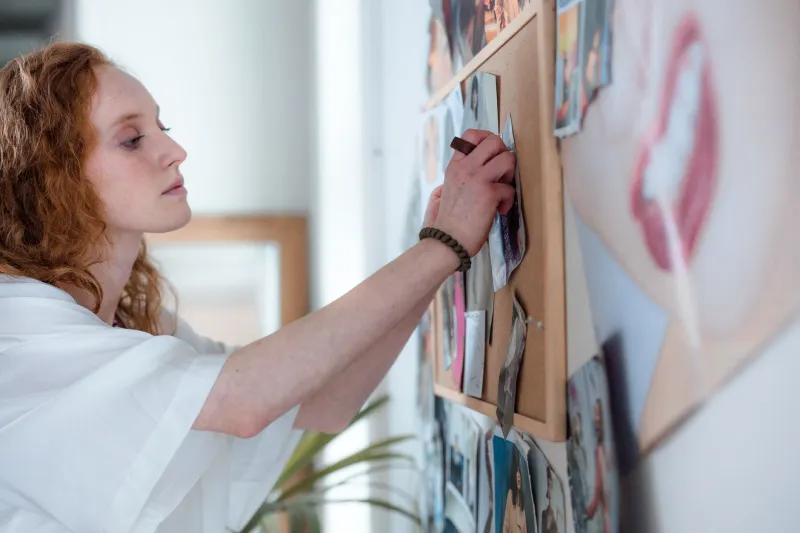
A genuine visual journal is less a presentation tool and more a private creative instrument. It is where a filmmaker records not just images that are beautiful, but images that provoke a specific, often difficult-to-articulate feeling. Directors who maintain these archives describe them as a form of self-interrogation — a way of asking, repeatedly and over time, "What kind of world do I actually want to put on screen?"
The practice takes many forms. Some directors maintain physical notebooks filled with printed photographs, torn magazine pages, postcards, and handwritten annotations. Others build elaborate digital collections using tools like Pinterest, Are.na, or custom folder systems on their hard drives. What matters is not the medium but the intention: every image is selected deliberately, and many are annotated with notes about why the image resonates, what quality of light is present, what emotional register it occupies.
The Annotation Is the Work
The annotation habit deserves particular attention, because it is where the real creative development occurs. Collecting images without reflection is simply curation. Writing about why an image compels you — even in rough, incomplete sentences — forces a translation between visual intuition and conscious understanding.
Consider what happens when a filmmaker writes, even briefly, about why a particular photograph of a diner at 3 a.m. keeps drawing their attention. Is it the quality of the fluorescent light against the darkness outside? The isolation of the single figure at the counter? The sense that time has become unstable? Working through that question on the page begins to surface aesthetic values that can then be applied intentionally on set.
Over months and years, these annotations accumulate into something resembling a personal aesthetic philosophy — one that the director did not invent so much as discover through sustained attention.
How Visual Archives Translate to the Set
The practical applications of this practice extend well beyond the development phase. Directors who maintain visual journals describe using them at multiple stages of production.
In pre-production, the archive becomes a precise communication tool. Rather than describing a desired visual tone in abstract language, a director can share specific images with their director of photography, production designer, or costume department and say, with confidence, "This. This quality of light. This relationship between figure and environment." The images carry information that words frequently cannot.
During production, the journal serves as a compass. Decisions on set — where to place the camera, how to light a face, what to include or exclude from the frame — are made faster and with greater clarity when a director has spent years developing a conscious understanding of their own aesthetic preferences.
In post-production, the archive can ground conversations with editors and colorists, providing visual reference points that keep the film's tone consistent across sequences that may have been shot weeks apart.
Building the Practice: A Framework for Emerging Filmmakers
For directors who have not yet established a visual journal habit, the entry point is simpler than it may appear.
Start with what already stops you. Rather than searching for images that seem "cinematic" or professionally approved, begin by collecting whatever genuinely arrests your attention — in film stills, photography books, architecture, painting, street photography, or anywhere else. The instinct that makes you pause in front of an image is data about your aesthetic sensibility.
Write before you curate. When an image is added to the archive, spend two to three minutes writing about it. The writing does not need to be polished. It needs to be honest. Over time, patterns will emerge that reveal consistent values and preoccupations.
Review and prune regularly. A visual journal that never gets revisited is simply a folder of saved images. Set aside time — monthly, quarterly — to move through the archive with fresh eyes. Some images will have lost their charge; remove them. Others will have deepened in significance. The images that endure across multiple reviews are the ones pointing toward something essential in your aesthetic identity.
Cross-reference across media. The most generative visual journals draw from the widest possible range of sources. Music, literature, architecture, fashion, and visual art all contain information about mood, tone, and spatial relationships that translates directly into filmmaking decisions. A director who only looks at film stills is limiting the breadth of their visual education.
The Long Game
Developing a signature visual style is not a project with a completion date. It is an ongoing process of self-discovery that unfolds across a career. The directors whose work is immediately recognizable — whose films carry a consistent atmosphere and way of seeing that persists regardless of subject matter — have typically been engaged in this kind of deliberate visual self-examination for years before their style became legible to audiences.
The visual journal is not a shortcut to that recognition. It is, rather, the practice that makes sustained aesthetic development possible. It transforms the acquisition of a personal style from an accident of temperament into a discipline that can be consciously cultivated.
For visual media professionals at any stage of their career, the invitation is straightforward: begin documenting what you see. The images you return to, the annotations you write, and the patterns that emerge across years of honest attention will, in time, tell you exactly what kind of filmmaker you are — and point clearly toward the work only you can make.