Bodies in Space: How the Most Purposeful Directors Use Movement as a Visual Language
Photo: Larissa Block, CC BY-SA 4.0, via Wikimedia Commons
The Frame as Stage
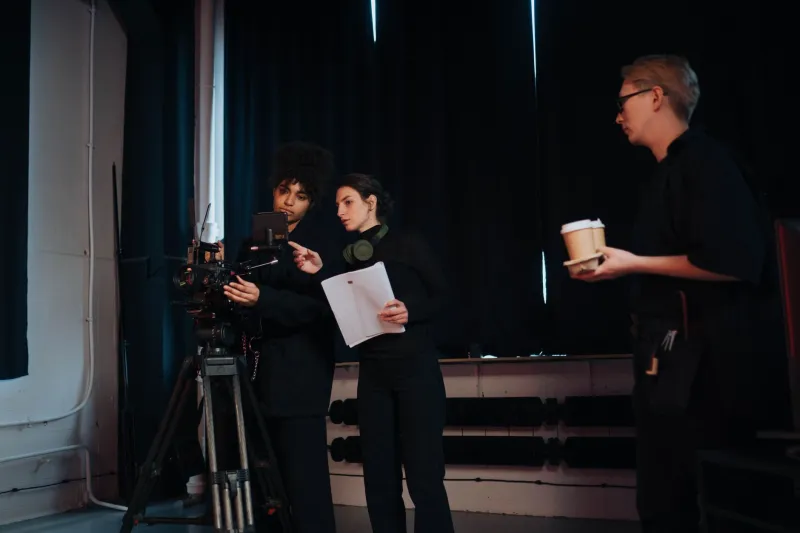
Every director, whether they have articulated it to themselves or not, is also a choreographer. The moment a scene is blocked — the moment decisions are made about where actors stand, how they move, and what the camera does in relation to them — a set of visual arguments is being advanced about who these people are, what they want from each other, and what the scene means in the larger architecture of the film.
Most of those arguments are never made explicit. They operate below the level of conscious audience attention, registering as feeling rather than analysis. A viewer watching two characters negotiate a difficult conversation will not typically think: the camera's gradual encroachment on the space between them is performing the pressure of the scene. They will simply feel that pressure, without knowing why. This is the nature of movement as a visual language — it communicates through sensation before it communicates through cognition, which is precisely what makes it so powerful and so demanding of intentional use.
Blocking as Argument
The term blocking — derived from the theater tradition of mapping actor positions on a gridded floor plan — understates the expressive range of what it describes. In its most sophisticated application, blocking is not the management of actor positions but the construction of a spatial argument about power, intimacy, isolation, and desire.
Consider the use of physical distance as a relational indicator. In naturalistic drama, characters who are emotionally close tend to occupy proximate space; characters in conflict tend to be separated. This is the baseline convention, and it is useful precisely because audiences have internalized it. But the most interesting directorial choices are those that complicate or subvert this convention — placing characters in close physical proximity to dramatize emotional distance, or separating them spatially to heighten the tension of suppressed connection.
The staging in Barry Jenkins' Moonlight operates extensively through this kind of spatial argumentation. The physical distance between Chiron and other characters is rarely incidental — it is a precise map of his psychological state at each moment in his development, a visual record of the walls he has built and the moments in which they briefly lower. Jenkins uses blocking not to illustrate emotional content that the script is already delivering but to carry emotional information that the script leaves unspoken.
Camera as Participant
The camera's relationship to actor movement is one of the most consequential creative decisions a director makes, and one of the least systematically discussed in mainstream filmmaking education. The camera can function as a passive observer, recording movement from a fixed position. It can function as a responsive companion, following movement in ways that feel organic and intimate. Or it can function as an active participant — moving in counterpoint to actors, creating visual tension through opposition, or advancing through space in ways that implicate the viewer in the scene's emotional dynamic.
Paul Thomas Anderson has developed one of the most distinctive camera-as-participant vocabularies in contemporary American cinema. His extended, complex takes — in which camera movement and actor movement are choreographed together in real time — create a sense of spatial unpredictability that keeps the viewer in a state of alert attention. The camera in an Anderson scene does not simply follow the action; it pursues, retreats, circles, and arrives at angles that feel both discovered and inevitable. The effect is not stylistic self-consciousness but a heightened sense of presence — the feeling that the viewer is inhabiting a space rather than observing it.
Kinetic Energy and Character Psychology
The way a character moves through space is one of the most direct expressions of their psychological state available to a director and actor in collaboration. Movement quality — the speed, weight, directionality, and spatial pattern of a character's physical behavior — communicates interior life with an immediacy that dialogue cannot always match.
This principle is well understood in dance and physical theater traditions that have only partially penetrated mainstream film practice. Directors who have worked extensively with movement-trained actors, or who have collaborated with choreographers on non-dance sequences, frequently report a qualitative shift in the expressive range available to them on set. When actors have a developed physical vocabulary — when they understand how to use the weight of their bodies, the quality of their transitions between positions, and the spatial patterns of their movement to externalize psychological states — the camera has richer material to work with.
The collaboration between director Luca Guadagnino and his actors on Call Me by Your Name and subsequent projects exemplifies this approach. Guadagnino is notably attentive to the quality of physical behavior in his scenes — the way characters inhabit or resist their environments, the small kinetic choices that reveal the gap between what a character is feeling and what they are allowing themselves to express. This attention to movement quality is not decorative; it is the primary vehicle through which Guadagnino's films communicate the interior lives of their characters.
Developing a Movement Vocabulary on Set
For directors who are working to develop a more intentional approach to movement in their own practice, several principles offer a productive starting point.
The first is to approach the blocking of every scene with a specific spatial question rather than a default arrangement. Before placing actors and camera, ask: what is the spatial argument of this scene? What does the physical relationship between these characters need to communicate that the dialogue will not? What should change — in the positions of bodies, in the relationship between camera and subject — between the beginning and end of the scene to reflect the emotional shift that has occurred?
The second is to develop a working relationship with actors around movement before the camera rolls. Rehearsal time devoted to spatial exploration — allowing actors to move freely through a set while the director observes, looking for physical behaviors that feel psychologically true — frequently produces blocking discoveries that purely intellectual pre-planning would not reach. The body knows things about character that the mind has not yet articulated.
The third is to study movement sequences from films whose spatial language you find compelling — not to replicate specific choices but to develop a vocabulary of possibilities. The extended takes of Tarkovsky, the precise spatial geometry of Kubrick, the fluid camera-actor choreography of Alfonso Cuarón: each of these represents a different answer to the question of how camera and body can move together in expressive relation. Sustained attention to these answers builds the perceptual intelligence necessary to develop original ones.
The Sentence Beneath the Sentence
Film theorists have long described the cinema as a language, and in the most productive readings of that metaphor, movement is its syntax — the structural layer beneath the visible content that determines how meaning is organized and delivered. A film that uses movement thoughtlessly is a film that is not using the full range of its expressive capacity. It is, in a meaningful sense, speaking in incomplete sentences.
The directors who have most fully mastered the visual medium are invariably those who have understood this. Their films communicate on multiple registers simultaneously — through dialogue, through performance, through image composition, and through the kinetic relationships between bodies and cameras in space. Learning to work at that level of intentionality is not a matter of technique alone. It is a matter of learning to think spatially, to see the frame as a field of relational energy, and to treat every movement within it as a choice that is already, whether consciously made or not, telling the audience something about the story.