The Space Between Words: Using Dialogue Rhythm as a Tool for Character and Power
Every screenwriting manual devotes considerable attention to what characters say. Comparatively few give sustained attention to how they say it — the duration of pauses, the frequency of interruptions, the rhythmic signature of a character's speech under different emotional conditions. Yet for editors and writers who work at the level of the sentence and the beat, these temporal qualities are not secondary to meaning. In many cases, they are the primary mechanism through which character is communicated.
This is not a peripheral craft concern. The rhythm of dialogue is one of the most direct pathways into the audience's intuitive understanding of who a character is, what they want, and how much power they hold in any given exchange. Editors who treat dialogue timing as a variable rather than a given — and writers who build rhythmic variation into their characters from the page — are working with a tool of considerable precision.
Why Rhythm Communicates Before Content Does
Human beings are extraordinarily sensitive to the prosodic qualities of speech — its tempo, rhythm, pause structure, and melodic contour. Long before we process the semantic content of what someone says, we have already registered an enormous amount of information about their emotional state, social confidence, and relational posture from the way they speak.
This sensitivity is not incidental. It is evolutionary. Our capacity to assess social dynamics and threat levels from vocal behavior predates our capacity for complex language comprehension. In practice, this means that when an audience watches a scene, they are simultaneously processing content and rhythm — and rhythm frequently wins the interpretive contest.
A character who speaks in complete, unhurried sentences with minimal filler language reads as authoritative regardless of what they are actually saying. A character whose speech is fragmented by hesitations, self-corrections, and incomplete thoughts reads as uncertain or subordinate — again, independent of semantic content. These readings happen automatically, below the level of deliberate analysis, which is precisely what makes them so powerful as characterization tools.
Mapping Speech Patterns to Character Psychology
For writers developing characters from the page, one of the most productive exercises is to construct a rhythmic profile for each principal character — a set of speech tendencies that reflect their psychology and social positioning.
Several variables are worth defining explicitly:
Pause behavior. Does the character pause before answering questions, or do they respond immediately? Pausing before speaking often signals internal processing, careful self-presentation, or strategic withholding. Immediate response can signal confidence, impulsivity, or defensiveness. The meaning depends on context, but the tendency itself communicates character.
Interruption pattern. Characters who interrupt frequently are asserting social dominance, whether consciously or not. Characters who allow themselves to be interrupted without reclaiming the floor are communicating deference, conflict avoidance, or suppressed anger. The interruption pattern within a scene is one of the most legible power maps available to an editor.
Sentence completion rate. Characters under psychological pressure frequently fail to complete sentences — not because they lack the words, but because the emotional or social stakes make full articulation feel dangerous. A character who begins five sentences and finishes none is communicating something very specific about their internal state, and an editor who allows those incompletions to breathe rather than cutting away from them is making a meaningful interpretive choice.
Speech tempo variation. Most people speak faster when anxious and more slowly when confident or deliberate. A character whose tempo accelerates when challenged is revealing something different from a character who slows down under the same conditions. These variations, written into the script and preserved in the edit, create a behavioral consistency that audiences register as authentic personality.
The Editor's Role in Dialogue Characterization
Screenwriters establish rhythmic tendencies, but editors are the practitioners who ultimately determine whether those tendencies survive into the finished film. And the editorial decisions made around dialogue timing can significantly alter — sometimes reverse — the audience's perception of who holds authority in a scene.
Consider a two-person scene in which Character A asks a question and Character B responds. The most straightforward editorial choice is to cut from A finishing the question to B beginning the answer. But the editor has several other options, each of which carries distinct characterization implications:
The held reaction. Cutting to B immediately after A's question but holding on B in silence before they speak extends the pause and emphasizes B's deliberateness. The same performance, held longer, reads as more considered — and therefore more powerful.
The early cut. Cutting to B before A has finished speaking — so that B's response begins over the tail of A's sentence — implies either eagerness, impatience, or dominance. The same line reading that appears deferential when it follows a full pause reads as assertive when it overlaps.
The late cut. Remaining on A after they have finished speaking, before cutting to B's response, places the weight of the scene's tension on A rather than B. The audience reads A's waiting as vulnerability, even if the dialogue content suggests otherwise.
These are not merely technical choices. They are authorial statements about the psychology of the scene, and they can be made independently of — or in tension with — what the dialogue itself appears to be saying. Some of the most sophisticated scenes in American cinema derive their complexity from exactly this tension between what characters say and what the editing communicates about the relational dynamics beneath the words.
Tracking Arc Through Rhythmic Evolution
One of the most underutilized applications of dialogue rhythm is as an instrument for tracking character arc across the length of a film. If a character's speech patterns change meaningfully between Act One and Act Three — if the hesitations decrease, if the interruptions increase, if the pauses shorten — the audience registers that change as behavioral evidence of transformation, which is far more convincing than any expository statement about who a character has become.
In No Country for Old Men, the Coen brothers and editor Roderick Jaynes use Anton Chigurh's rhythmic consistency — the unhurried, complete sentences; the absence of filler language; the willingness to allow long silences — as the primary mechanism through which his menace is communicated. The character barely raises his voice across the entire film. His authority is constructed entirely through the rhythmic confidence of his speech. By contrast, the characters who interact with him frequently become rhythmically destabilized — their speech fragmenting, their sentences trailing — which maps the power differential with precision that no line of dialogue could achieve as economically.
Practical Frameworks for Writers and Editors
Several practical approaches can help integrate dialogue rhythm into the development and editorial process:
Read dialogue aloud with a timer. Writers who read their scenes aloud while tracking the duration of pauses will quickly identify where rhythmic variation is absent or unintentional. Scenes in which every character speaks at the same tempo and with the same pause structure are scenes in which character differentiation is being left to performance alone.
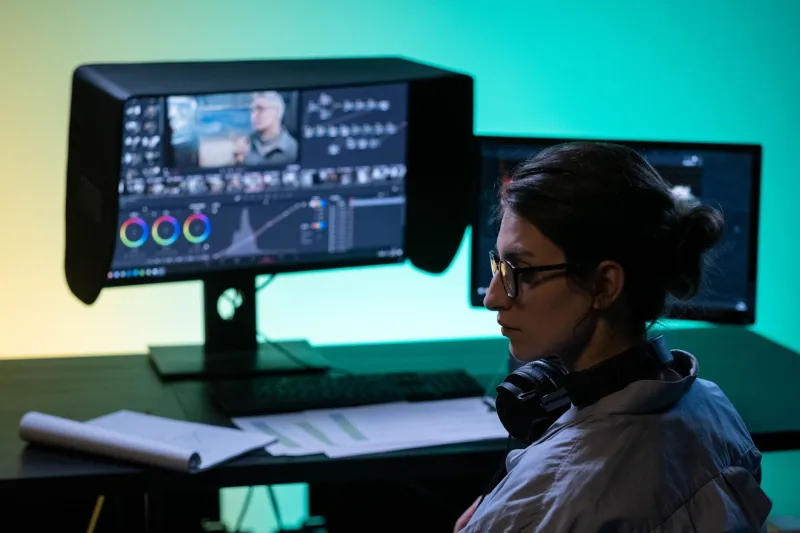
Create rhythmic transcripts of your cuts. Editors working on dialogue-heavy scenes benefit from mapping the actual durations of pauses, overlaps, and held reactions in their assembly. Seeing these durations as data often reveals patterns — or their absence — that are difficult to perceive in real-time playback.
Treat silence as performance. The most common editorial error in dialogue scenes is cutting away from a character the moment they stop speaking. Silence after speech is frequently where the most important behavioral information lives. Developing the discipline to hold on a character through their post-speech silence — and to make that decision intentionally rather than defaulting to coverage — is among the highest-yield skills an editor can build.
The Rhythm Beneath the Words
Dialogue, at its most functional, conveys information. At its most powerful, it reveals psychology — the gap between what a character says and what they mean, between the surface of the conversation and the relational dynamics operating beneath it. That revelation happens not through content but through rhythm: the length of the pause, the timing of the interruption, the sentence that begins and does not end.
For editors and writers who develop fluency in this dimension of their craft, the dialogue scene becomes something considerably richer than an exchange of lines. It becomes a behavioral map — a precise, legible record of who these people are and what they need from each other. And that map, read correctly, tells the audience everything.