Shake as Syntax: The Deliberate Grammar of Handheld Cinematography

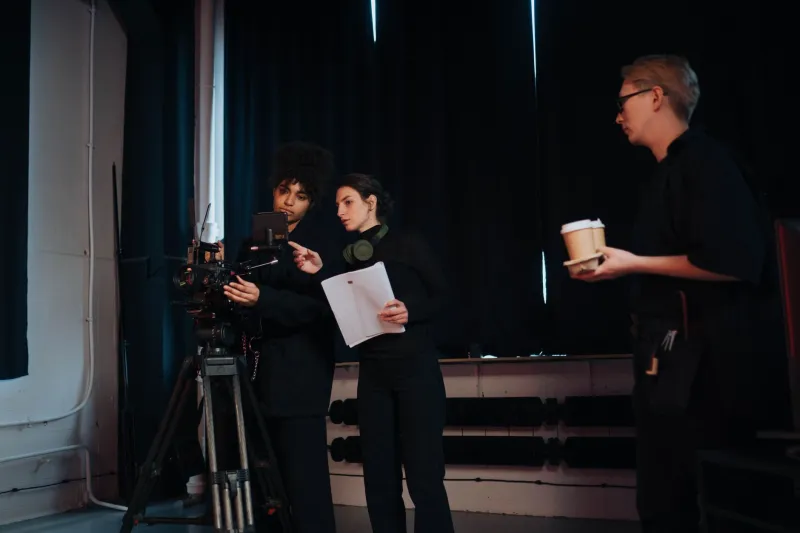
Photo: cinematographer operating handheld camera on film set, via cdni.autocarindia.com
For most of early cinema's history, a moving camera was a problem to be solved. The jitter of an improperly stabilized shot, the subtle drift of a frame searching for its subject, the micro-vibrations that betrayed a human hand holding the mechanism—these were failures. They interrupted the invisible contract between screen and viewer, reminding the audience that someone was behind the glass.
Something shifted. Over the past four decades, and with increasing velocity in the past fifteen years, handheld cinematography has undergone a fundamental reclassification. What was once a technical deficiency is now a deliberate expressive choice—a form of visual syntax as codified and intentional as any other element of the cinematographer's craft.
Understanding how this transformation happened, and what it means for working visual media professionals today, requires looking at both the historical arc and the specific mechanics of how movement communicates meaning.
The Roots of Instability as Intention
The handheld aesthetic did not emerge from Hollywood. It arrived from the documentary tradition—specifically, from the cinéma vérité movement of the late 1950s and early 1960s, when French and American filmmakers began using lighter 16mm cameras to capture reality as it unfolded rather than as it was staged.
Directors like John Cassavetes imported that raw, unpolished visual vocabulary into narrative fiction. His films—Shadows, A Woman Under the Influence, The Killing of a Chinese Bookie—used handheld work not to simulate documentary reality but to generate a specific emotional register: closeness, volatility, the sense that the world on screen might fracture at any moment. The camera's physical instability became a metaphor for psychological instability.
This was a conceptual breakthrough. The camera was no longer a neutral recording device. It was a participant, and its physical relationship to the subject communicated information that no compositional choice, lighting scheme, or performance note could replicate.
Degrees of Movement: A Working Taxonomy
One of the most persistent misconceptions about handheld cinematography is that it operates as a single undifferentiated technique. In practice, skilled cinematographers work with a nuanced spectrum of movement types, each carrying distinct emotional implications.
Micro-tremor and drift represent the subtlest end of the spectrum. Nearly imperceptible in isolation, these small imprecisions accumulate over the course of a scene to create a sense of unease or emotional fragility. Roger Deakins has employed this register in intimate dramatic scenes where a locked-off shot would feel clinical and detached—the slight instability signals that the moment is alive, that it might tip in any direction.
Reactive movement—where the camera appears to respond to action rather than anticipate it—is the grammar of immediacy. The camera finds its subject a half-beat late, adjusts, reframes. This creates the impression of a witnessing consciousness rather than an omniscient one, pulling the viewer into the experiential position of someone present in the scene rather than observing it from outside.
Aggressive instability—the full-body, high-energy handheld work associated with action sequences or psychological crisis—is the most recognizable register and, paradoxically, the most frequently misused. When deployed without structural intention, it reads as chaos. When deployed with precision, it becomes the visual equivalent of a racing pulse.
The distinction between these registers is not merely technical. It is rhetorical. A cinematographer choosing a movement register is making an argument about how the audience should relate to what they are seeing.
Character Agency and the Camera's Relationship to the Subject
One of the most sophisticated applications of handheld technique involves using the camera's physical relationship to a character as a marker of that character's psychological agency.
Consider the difference between a camera that leads a character through space—anticipating their movement, staying ahead of them—versus one that trails, struggling to keep pace. The first implies control, authority, intention. The second implies pursuit, desperation, or loss of direction. Neither requires dialogue or exposition. The information is encoded in the camera's behavior.
Cinemographer Emmanuel Lubezki's work on Birdman (shot in collaboration with director Alejandro González Iñárritu) offers a sustained example of this principle. The film's relentless, seemingly unbroken handheld movement functions not as stylistic flourish but as psychological portrait. The camera's inability to settle, its constant repositioning around the protagonist, externalizes a mind that cannot find equilibrium. Stability, in that context, would have been a lie.
Teaching the Shake
For emerging cinematographers, the practical challenge is learning to distinguish between handheld work that communicates and handheld work that merely agitates. Several principles guide this development.
Motivation precedes movement. Before picking up the camera, articulate—specifically—what emotional or psychological information the movement is meant to convey. Vague intentions produce vague results. If the answer is "it'll feel more real," that is not sufficient justification. Real compared to what? Real in service of what emotional objective?
Contrast is the mechanism. Handheld work derives much of its power from contrast with more stable imagery. A film shot entirely handheld eventually normalizes the instability, eliminating its expressive charge. The most effective deployments of handheld technique exist in relationship to other registers—locked-off wide shots, smooth tracking moves—that establish a baseline from which the handheld work departs meaningfully.
The operator's body is an instrument. Breathing, weight distribution, and physical tension all transmit through the camera to the image. Cinematographers who approach handheld work physically—who think about how their body's relationship to the camera affects the image—develop a far more nuanced range of movement than those who treat it as a purely mechanical problem.
Lens choice amplifies or moderates. Wider lenses absorb movement; longer lenses amplify it. A 35mm lens in a handheld operator's hands reads very differently than a 100mm lens in the same hands. Understanding this relationship allows the cinematographer to calibrate the apparent intensity of movement independently of the actual physical motion being produced.
The Settled Question
Handheld cinematography is no longer a debate in serious visual media circles. It has been absorbed into the full vocabulary of the craft, available to any cinematographer who understands its logic. The question is no longer whether instability belongs in professional filmmaking. The question is whether the practitioner has developed enough fluency in this grammar to deploy it with the precision that intentional storytelling demands.
Shake is a word. Drift is a phrase. The cinematographer's job is to construct a sentence that means something.