The Quiet Architect: How the Colorist Becomes the Final Author of Your Film
There is a particular kind of professional in the film and video industry who shapes what you see without ever appearing in a credit that audiences read. They do not direct actors, design costumes, or compose music. They sit in a darkened room, often alone, surrounded by calibrated monitors and a control surface that resembles a mixing board crossed with a spacecraft console — and they make decisions that will define the emotional register of every frame in the final cut.
The colorist is the last person to touch your film. In many ways, they may be the one who defines it.
This is not a popular opinion in production circles where the director of photography is rightly celebrated as the visual architect of a project. But spend time talking to working colorists across the United States — from boutique post houses in Los Angeles to independent grading suites in Atlanta and Austin — and a consistent picture emerges: color grading is among the most misunderstood and undervalued crafts in visual media, and that misunderstanding costs productions in ways that are difficult to quantify but impossible to ignore.
What Color Actually Does to an Audience
Before addressing the industry dynamics, it is worth establishing what color grading is actually accomplishing at the perceptual level, because it is far more than aesthetic decoration.
Color communicates mood before narrative context arrives. A desaturated teal-and-orange palette signals gritty realism to an American audience conditioned by two decades of action cinema. Warm golden tones suggest nostalgia, safety, or the irretrievability of the past. High-contrast, cool shadows connote institutional coldness or moral ambiguity. These associations are not accidental — they have been built through repetition across thousands of productions, and audiences absorb them without conscious awareness.
The colorist's role is to harness those associations with precision. They are not simply correcting exposure or balancing white points, though that technical work is foundational. They are constructing an emotional argument about what the audience should feel in each scene, and they are doing it with tools that operate below the threshold of conscious perception.
Building Iconic Palettes: The Craft Behind the Look
Consider the visual language of prestige television drama over the past decade. Productions like Ozark, Mindhunter, and Succession each developed instantly recognizable color identities that reinforced their thematic content. Ozark's blue-drained, desaturated palette was not a camera choice alone — it was a grading decision that transformed the Missouri Ozarks into a place where warmth and safety had been systematically removed. Succession's slightly cooler, flatter treatment of its interiors gave the Waystar universe a corporate sterility that underlined every scene of familial betrayal.
These looks are built collaboratively, typically beginning with a conversation between the director of photography and the colorist during pre-production — ideally before a single frame is shot. The best colorists in the American industry describe their process as beginning with a creative brief, not a timeline. They want to understand the story before they see the footage.
"I need to know what the film is about emotionally before I can make a single node decision," says one Los Angeles-based colorist who has worked on multiple independent features that have screened at major domestic festivals. "If I'm just reacting to what's in front of me technically, I'm doing correction. If I understand the story, I'm doing color."
That distinction — between correction and storytelling — is at the heart of the craft's identity crisis.
The Correction Booth Misconception
The persistent industry habit of treating the grading suite as a correction booth rather than a creative space has real consequences. Productions that bring in a colorist only after picture lock, with a compressed timeline and a fixed creative brief, are not utilizing the craft — they are applying a finish coat and calling it a mural.
This approach is particularly common in commercial video production, branded content, and lower-budget independent film, where post-production schedules are frequently the first casualty of budget overruns. The colorist inherits whatever was shot, however it was lit, and is expected to make it look intentional.
Some can. The best colorists are skilled at finding the latent visual logic in footage that was not shot with a specific grade in mind. But that is damage control, not collaboration, and the results reflect the difference.
The productions that achieve the most cohesive and emotionally resonant visual identities are invariably those where the colorist was involved early, given creative latitude, and treated as a peer to the cinematographer rather than a technician downstream of the real creative work.
DaVinci Resolve and the Democratization of the Grade
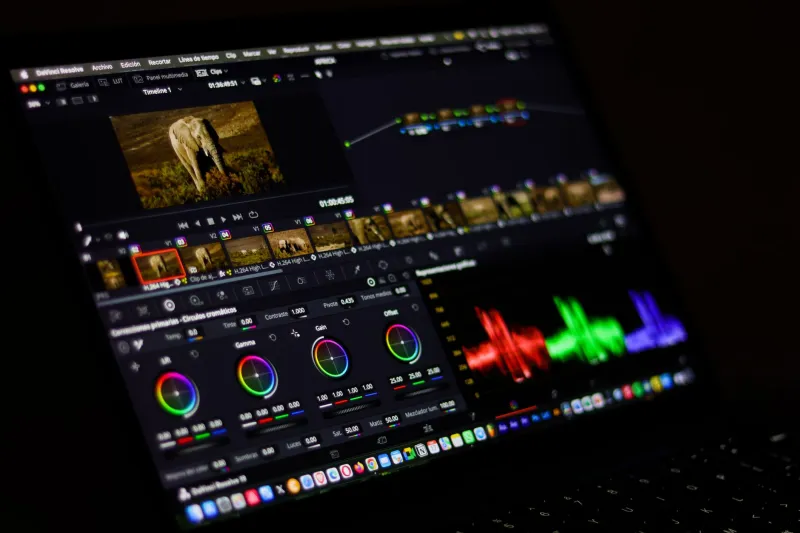
The conversation about color grading has shifted significantly in the past several years, driven in large part by Blackmagic Design's DaVinci Resolve. Once a high-end system available only to major post houses, Resolve is now available in a fully functional free version that runs on standard consumer hardware — and its professional version carries a one-time license fee that is accessible to independent creators.
The result has been a genuine democratization of professional-grade color tools. Indie filmmakers across the US are now performing sophisticated primary and secondary corrections, applying node-based grading structures, and working with HDR color spaces on productions that would previously have had no access to those capabilities.
This is unambiguously positive for the industry's creative output. It is also, some working colorists note, creating a new challenge: the availability of powerful tools does not automatically confer the perceptual training and storytelling instinct that distinguish great color work from technically competent color work.
Resolve can be learned. Learning to see color — to understand what a particular hue shift does to the emotional temperature of a scene, to recognize when a grade is fighting the story rather than serving it — requires a different kind of education, one that is best acquired through deliberate practice, mentorship, and a serious engagement with the history of visual media.
Treating the Suite as a Storytelling Room
For directors, producers, and cinematographers reading this, the practical implication is straightforward: involve your colorist earlier, give them the story, and attend the grade.
The grading session should not be a technical approval process. It should be a creative conversation. Bring your reference images, your mood boards, your notes on what each scene needs to accomplish emotionally. Ask your colorist what they see in the footage. Their perspective, shaped by thousands of hours of visual analysis, will frequently surface possibilities that were not visible on set.
For independent creators using Resolve or similar tools to self-grade, the discipline of separating the edit from the grade is worth maintaining. Color decisions made in the middle of an edit are reactive. Color decisions made after picture lock, with the full film in view, can be genuinely architectural.
The moving image is, at its most fundamental level, a play of light. The colorist is the professional entrusted with shaping that light after it has been captured — giving it meaning, consistency, and emotional direction. That responsibility deserves recognition commensurate with its influence.
The last person to touch your film is not the one who finishes it. They are, in a very real sense, the one who completes it.